The Scale Model Collector’s Guide to the World’s Greatest Fighter Jets
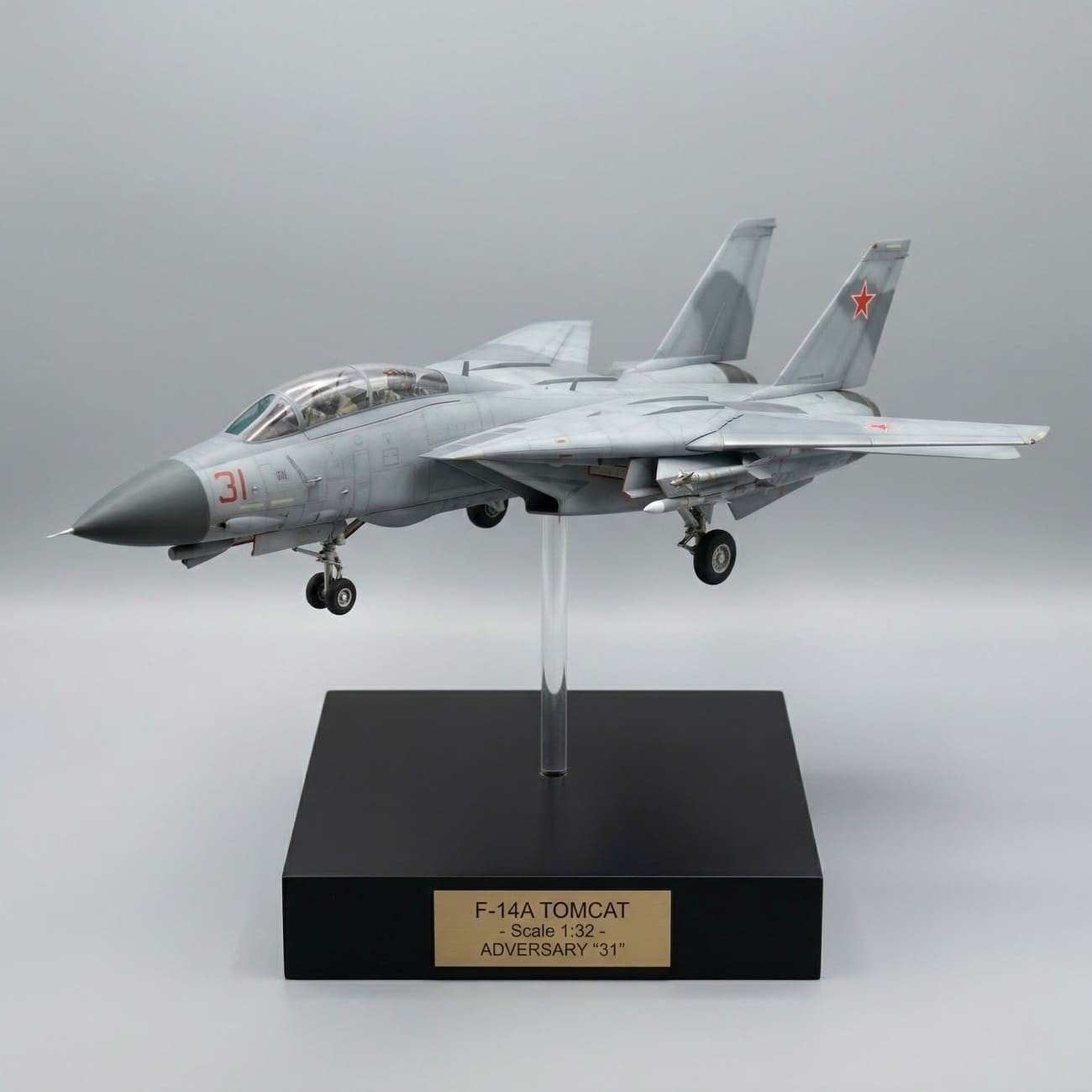
Fighter aircraft are the most demanding subjects in aviation collecting — and the most rewarding. Every design decision in a combat aircraft is driven by the absolute requirement to outperform an adversary at the edge of what physics permits. That engineering extremity is visible in the form: the razor-thin wing of the F-104 Starfighter, the variable-geometry sweep of the F-14 Tomcat, the faceted stealth surfaces of the F-117 Nighthawk. These are shapes that carry their own logic, and that logic reads at any scale. A well-executed fighter at 1:48 tells you everything about the aircraft’s operational philosophy before you have read a single word about its history.
This guide covers the fighter subjects that matter most in the serious collector market — the aircraft with the strongest historical significance, the deepest research bases, and the most compelling three-dimensional presence at scale. For each subject, scale recommendations and what to look for in a quality replica are included.
World War II — Where Fighter Aviation Found Its Identity
Supermarine Spitfire — The Definitive WWII Fighter Subject
Recommended scale: 1:48 or 1:32 — Best for: collectors at every level, Battle of Britain markings, RAF squadron displays
No fighter aircraft has generated more collector attention, more kit releases, or more debate about marking accuracy than the Spitfire. The elliptical wing — designer R.J. Mitchell’s aerodynamic masterstroke — is the detail that separates a quality airplane model from a mediocre one. Get the wing planform wrong and the entire silhouette fails. Get it right and the Spitfire is immediately and unmistakably itself at any scale. The Mk.I in early Battle of Britain camouflage, the Mk.IX in Mediterranean desert scheme, the Mk.XIV with its five-blade Griffon-driven propeller — each variant carries its own marking opportunities and its own place in the historical narrative.
North American P-51D Mustang — America’s Definitive Long-Range Escort
Recommended scale: 1:48 or 1:32 — Best for: USAAF 8th Air Force displays, Tuskegee Airmen markings, personal nose art subjects
The P-51D is the American counterpart to the Spitfire in the collector hierarchy — a subject with almost unlimited marking options and a research base deep enough to support the most demanding accuracy requirements. The 8th Air Force alone flew the type in hundreds of individual nose art schemes, each documented in period photography that allows precise recreation at scale. The distinctive bubble canopy, the laminar-flow wing, and the Packard Merlin’s chin intake are the key accuracy checkpoints. A P-51D in the red-tailed markings of the 332nd Fighter Group is among the most historically resonant fighter subjects in the entire WWII collecting category.
Mitsubishi A6M Zero — The Pacific War’s Most Misunderstood Fighter
Recommended scale: 1:48 — Best for: Pacific theatre displays, Pearl Harbor markings, carrier aviation subjects
The Zero entered Allied consciousness at Pearl Harbor in 1941 as a complete tactical surprise — a carrier-based fighter with range and manoeuvrability that Western intelligence had assessed as impossible for a Japanese design. At 1:48 scale, the A6M2’s round cowling, distinctive wing shape, and characteristic drop tank configuration make it an immediately recognisable and visually elegant model aircraft subject. Its historical significance as the aircraft that temporarily shifted Pacific air superiority to Japan gives it a collector weight that pure performance metrics alone would not justify.
The Cold War Generation — Speed, Altitude, and the Nuclear Edge
North American F-86 Sabre — The First Jet-Age Fighter Collector Subject
Recommended scale: 1:48 or 1:72 — Best for: Korean War displays, USAF markings, Sabre vs MiG-15 pairing subjects
The F-86 Sabre’s swept wing configuration — borrowed directly from captured German wartime research — gave it the edge over the similarly swept Soviet MiG-15 in the skies over Korea. The MiG-15/F-86 pairing is one of the most compelling display concepts in Cold War aviation collecting: two aircraft that represented the first jet-versus-jet air combat in history, produced by opposing superpowers from the same theoretical foundation, facing each other across the 38th Parallel. A matched pair at consistent scale, marked to specific confirmed kill aircraft, is among the most historically substantive displays a Cold War collection can produce.
Grumman F-14 Tomcat — Variable Geometry and Cultural Permanence
Recommended scale: 1:48 or 1:72 — Best for: US Navy carrier displays, Top Gun markings, variable sweep wing demonstration models
The F-14 Tomcat’s variable-geometry wing — sweeping from 20 degrees for carrier launch to 68 degrees at supersonic dash — makes it one of the most visually dramatic subjects in the entire large scale planes collector category. At 1:48, a fully spread-wing Tomcat in VF-84 Jolly Rogers markings — the black skull and crossbones scheme — is one of the most visually commanding display pieces in Cold War military aviation collecting. The F-14’s cultural visibility, amplified by Top Gun in 1986 and its 2022 sequel, gives it a collector audience that extends well beyond the core military aviation community.
Lockheed SR-71 Blackbird — The Fastest Airplane Model Subject in Any Collection
Recommended scale: 1:72 or 1:48 — Best for: reconnaissance aircraft displays, black scheme statement pieces, Skunk Works subjects
The SR-71 held the air speed record for a manned air-breathing aircraft from 1976 until its retirement — Mach 3.3, 85,000 feet, with a titanium airframe that expanded several inches in flight due to aerodynamic heating. As a display subject, its all-black finish, chined fuselage, and twin-nacelle configuration give it a presence unlike anything else in a collection. At 1:72, the SR-71’s length reproduces at approximately 550mm — a significant but manageable display piece. At 1:48, it commands a shelf entirely on its own terms, which is exactly how the real aircraft operated.
Modern and Stealth — The Current Frontier of Fighter Collecting
Lockheed Martin F-22 Raptor — Fifth Generation at Scale
Recommended scale: 1:72 or 1:48 — Best for: modern USAF displays, stealth aircraft collections, air superiority subject studies
The F-22 Raptor represents the current apex of air superiority fighter design — supercruise capability without afterburner, all-aspect stealth, thrust-vectoring nozzles, and an avionics suite that fuses sensor data in ways no previous fighter generation approached. As a scale fighter jet model, the F-22’s trapezoidal wing, canted tail surfaces, and weapon bay door seams are the accuracy checkpoints that separate a serious collector piece from a production approximation. The limited number of manufacturers who have tooled the F-22 at 1:48 with adequate accuracy makes well-executed examples relatively scarce — a scarcity that the serious collector market has noted.
Lockheed Martin F-35 Lightning II — The Most Controversial Modern Fighter Subject
Recommended scale: 1:72 or 1:48 — Best for: multi-nation operator displays, STOVL variant studies, current-generation collections
The F-35 programme’s complexity — three variants, fifteen operator nations, two decades of development controversy — makes it the most documentable modern fighter subject in collecting. The F-35B’s lift fan and rotating nozzle for short takeoff and vertical landing, the F-35C’s larger wing and folding tips for carrier operations, and the F-35A’s conventional configuration offer three distinct model planes subjects within a single programme. A collection representing all three variants in different operator liveries — USAF, Royal Air Force, and JASDF, for example — documents both the aircraft’s engineering breadth and its geopolitical footprint simultaneously.
A fighter jet collection is not just a display of aircraft. It is a compressed history of the technological arms race that defined the twentieth century — and the scale at which you choose to tell that story determines how much of it your collection can carry.
Scale and Format: What Every Fighter Jet Collector Needs to Know
Scale choice in fighter jet collecting involves trade-offs between display space, detail level, and subject availability:
- 1:72 — The broadest subject range and most extensive diecast airplane store availability. Ideal for multi-aircraft era displays and space-conscious collectors. Detail is strong but requires magnification to appreciate fully.
- 1:48 — The serious collector standard for fighter subjects. Surface panel lines, cockpit detail, and weapons load are all legible at arm’s length. The right scale for most display purposes.
- 1:32 — Premium large scale planes territory. Individual rivet detail, cockpit instrumentation, and wheel well geometry are all reproducible. Demands significant display space — a 1:32 F-14 runs to approximately 650mm in length.
- Commission builds — For subjects unavailable through standard production, or for collectors requiring specific markings and configurations not covered by any kit or diecast release, commissioned builds from specialist makers represent the top of the market at any scale.
Frequently Asked Questions
What is the best scale for fighter jet models?
1:48 is the most widely recommended scale for serious fighter jet collecting — it balances displayable physical size with a level of surface and cockpit detail that rewards close inspection. Collectors building large multi-aircraft era displays often prefer 1:72 for the broader subject range and reduced footprint. For premium statement pieces where a single aircraft dominates a display, 1:32 produces the most visually commanding result.
Where is the best place to find diecast fighter jet airplane models?
Specialist diecast airplane store suppliers and dedicated scale model retailers carry the widest range of fighter subjects across all scales. For subjects not available through standard production — specific markings, rare variants, or large scale planes at 1:32 and above — commissioned builds from specialist workshops are the appropriate route. Online communities and collector forums are also valuable resources for locating discontinued or limited-edition releases in the secondary market.
Which WWII fighter makes the best starting point for a new collector?
The Supermarine Spitfire is the most recommended starting point for new military aviation collectors — the widest range of quality airplane model options at 1:48 and 1:72, the deepest research base for marking accuracy, and the strongest resale market for quality pieces. The P-51D Mustang is the strongest alternative for collectors with a particular interest in American WWII aviation. Both subjects offer enough variant and marking diversity to sustain a focused collection independently.
What makes a fighter jet model worth collecting versus a generic display piece?
Four criteria separate a collectible models of automobiles-grade piece from a generic display item: geometric accuracy to the specific variant represented; correct surface finish and panel line representation; historically verifiable marking scheme with accurate colour references; and manufacturer reputation for consistent quality across production runs. A fighter jet model that meets all four criteria holds its value and commands respect from informed collectors. One that compromises on any of them is a display item rather than a collectible — and the difference is immediately visible to anyone who knows the subject.
Build a Collection That Tells the Full Story
A fighter jet collection built with genuine historical intention — spanning the WWII piston era, the early jet age, the Cold War supersonic generation, and the current stealth platforms — is one of the most complete narratives in scale collecting. Each aircraft in the progression represents a specific response to a specific threat environment, and the sequence of those responses tells the story of how aviation technology and geopolitics shaped each other across eighty years.
The Spitfire and the F-22 are separated by eighty years of development, two revolutions in propulsion technology, and an almost incomprehensible advance in avionics capability. At consistent scale, side by side on the same shelf, they tell that entire story without a word of explanation. That is what a well-chosen collection does — and why the collector who builds it with knowledge and patience ends up with something considerably more interesting than a shelf full of aircraft.
Start with the subject that means most to you. Get the scale right. Verify the marking accuracy. Display it properly. The collection that builds from there will reflect the history it documents — and hold the value that serious collecting always produces.